






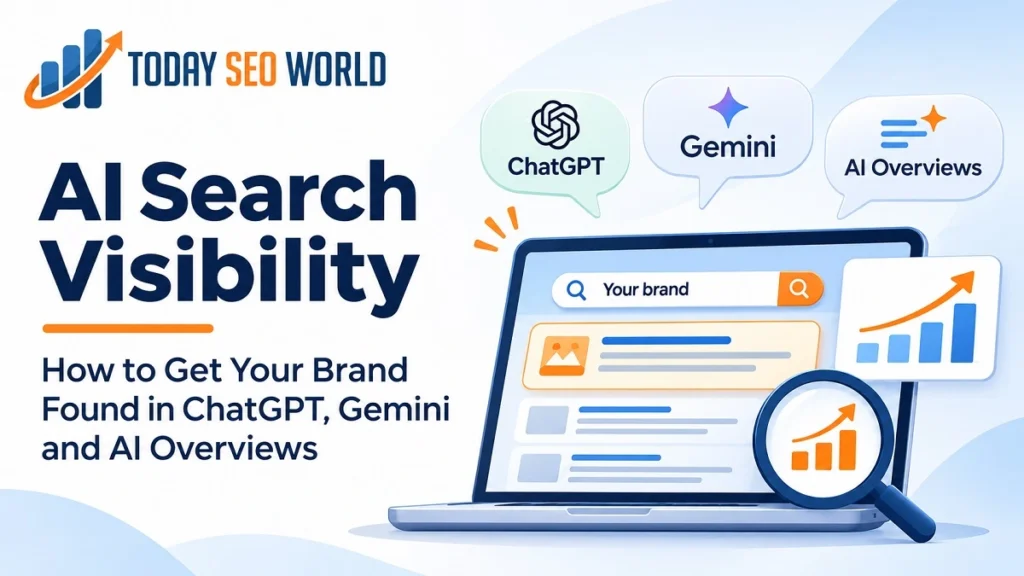
What Is AI Search Visibility?
AI search visibility is how often, and how favorably, your brand appears in answers generated by AI search tools. It works at three levels:
- Mention: the answer names your brand.
- Citation: the answer links to your page as a source.
- Recommendation: the answer suggests your brand as a good option for the user’s need.
You’ll also see this work called GEO, AEO or LLM visibility. The terms describe the same goal from slightly different angles.
| Term | What it means |
| AI search visibility | How often your brand appears in AI-generated answers |
| GEO (generative engine optimization) | Optimizing content and brand signals for AI tools that generate answers, such as ChatGPT and Gemini |
| AEO (answer engine optimization) | Structuring content so it can be used as the direct answer to a question |
| LLM visibility | Your presence in answers from tools built on large language models |
| AI Overviews and AI Mode | Google’s AI-generated answers inside Google Search |
Google’s position is clear: in its guide to optimizing for generative AI features, it says optimizing for generative AI search “is optimizing for the search experience, and thus still SEO.”
How AI Search Engines Choose Their Sources
Most AI search tools don’t answer purely from memory. They search the web, read the pages they find and cite the most useful ones. That means each platform’s search index decides whether you can be cited at all.
| Platform | Where it finds sources | What you need to do |
| Google AI Overviews and AI Mode | Google’s search index and ranking systems; they can run several related searches (“query fan-out”) to build one answer | Get indexed in Google, stay eligible to show with a snippet, and allow Googlebot |
| Google Gemini | Gemini Apps can ground answers in Google Search results | Allow Googlebot, and keep Google-Extended allowed if you want your content used for grounding in Gemini Apps |
| ChatGPT search | OpenAI’s OAI-SearchBot crawler | Allow OAI-SearchBot; OpenAI says opted-out sites “will not be shown in ChatGPT search answers” |
| Perplexity | Its own index, built by PerplexityBot | Allow PerplexityBot |
| Microsoft Copilot | Bing’s index | Allow Bingbot and set up Bing Webmaster Tools |
| Claude | Web search, supported by Anthropic’s Claude-SearchBot crawler | Allow Claude-SearchBot |
Some AI bots are for training models, not search. OpenAI’s GPTBot and Anthropic’s ClaudeBot collect content that may be used for training, so you can block them and still appear in ChatGPT and Claude search results. OpenAI’s crawler documentation explains the difference. Google-Extended is similar: Google says it “does not impact a site’s inclusion in Google Search nor is it used as a ranking signal”, though blocking it stops your content being used to ground answers in Gemini Apps.
AI Search Visibility vs Traditional SEO
The two overlap far more than they differ. Pages that rank well are more likely to be found and cited, so strong SEO is still the foundation.
| Traditional SEO | AI search visibility | |
| Goal | Rank pages in search results | Be mentioned, cited or recommended in AI answers |
| What you get | Clicks from search results | Mentions and citations, often with fewer clicks |
| What matters most | Relevance, quality, links and technical health | The same, plus clear answers and how widely your brand is talked about |
| What competes | Whole pages | Passages, facts and brands |
| How you measure it | Rankings, impressions and clicks | Mentions, citations, AI impressions and AI referral traffic |
How to Improve Your AI Search Visibility: 9 Steps
1. Let AI Search Crawlers Reach Your Site
Check that your robots.txt file doesn’t block Googlebot, Bingbot, OAI-SearchBot, PerplexityBot or Claude-SearchBot. If your robots.txt has no rules for these bots, they’re already allowed, so you only need to act if you’ve blocked them before. OpenAI recommends “allowing OAI-SearchBot in your site’s robots.txt file” to appear in ChatGPT search, and Perplexity gives the same advice for PerplexityBot.
Also check that your firewall, security plugin or CDN isn’t blocking these bots by mistake. Some security settings block unfamiliar bots by default.
2. Get Your Pages Indexed in Google and Bing
Google says a page must be “indexed and eligible to be shown in Google Search with a snippet” to appear as a link in AI Overviews and AI Mode. Submit your sitemap in Google Search Console and Bing Webmaster Tools, and use IndexNow to tell Bing about new and updated pages quickly.
Avoid the nosnippet tag and very short max-snippet limits on pages you want cited, because they restrict what Google can show from your page.
3. Answer Questions Directly
AI answers tend to use passages that answer a question clearly and completely. Put a short, direct answer at the top of each page and each section, then add the detail.
- Use the questions your customers actually ask as headings
- Answer in the first one or two sentences under each heading
- Define terms plainly before going deeper
- Use numbered steps, lists and tables for processes and comparisons
Write for people first. Google says there’s “no requirement to break your content into tiny pieces for AI to better understand it,” and clear writing helps both readers and AI.
4. Show Real Experience and Expertise
Content that repeats what’s already online gives AI tools no reason to cite you. Google says unique, useful content is likely to influence your visibility in its AI features more than anything else, noting that “a first-hand review provides a unique perspective based on personal experience.”
Add what only you have: original data, case studies, real examples, photos, prices and expert quotes. Name the author and explain why they’re qualified to write about the topic.
5. Structure Your Pages Clearly
Clear headings, short paragraphs, lists and tables help people and AI systems find the right passage quickly. Google says structured data isn’t required for AI search, but it still supports normal search features, so keep using it for your organization, articles, products and reviews.
6. Keep Your Brand Facts Consistent Everywhere
AI tools build a picture of your brand from many sources. If your name, description, services, prices or locations differ between your website, social profiles and directory listings, AI answers may repeat the wrong details.
- Write one clear brand description and use it everywhere
- Keep your About and Contact pages up to date
- Add Organization structured data that links to your official social profiles
- Keep your Google Business Profile and directory listings accurate, such as a free agency profile on Today SEO World if you run an agency
7. Earn Genuine Mentions on Trusted Websites
How often other websites talk about your brand appears to matter a great deal. In Ahrefs’ study of 75,000 brands, branded web mentions had the strongest correlation with AI Overview visibility (0.664), well ahead of the number of backlinks (0.218). Correlation doesn’t prove cause, but the pattern is clear: brands that people talk about are the brands AI talks about.
Ways to earn mentions:
- Publish original research or data that others want to quote
- Get featured in industry publications, podcasts and expert roundups
- Collect reviews on trusted review sites and directories
- Take part genuinely in communities where your customers ask questions
Avoid shortcuts. Google warns that “seeking inauthentic ‘mentions’ across the web isn’t as helpful as it might seem.”
8. Keep Your Content Fresh and Accurate
AI search tools pull current pages from their search indexes to ground their answers. Review your most important pages regularly, update facts, prices and screenshots, and show a “last updated” date. Outdated pages are less useful to cite and can lead AI answers to repeat old information about your brand.
9. Track Your AI Visibility Every Month
You can’t improve what you don’t measure. Set up the reports and checks in the measurement section below, and review them monthly alongside your SEO reporting.
What Doesn’t Work for AI Search Visibility
AI search has attracted plenty of quick-fix advice. These tactics waste time or carry risk:
- LLM.txt files for Google. Google says adding one “will neither harm nor help your site’s visibility or rankings in Google Search, as Google Search ignores them.” Some other AI tools may read them, but there’s no clear evidence yet that they improve visibility.
- Special AI files or markup. Google says you don’t need new machine-readable files, AI text files or special markup to appear in its AI features.
- Chopping content into tiny chunks. It isn’t required. Well-structured pages written for people work best.
- Mass-produced AI content. Publishing large volumes of thin pages to manipulate rankings goes against Google’s guidance and gives AI tools nothing new to cite.
- Fake mentions and reviews. Paid or fake mentions, review swaps and spammy forum posts can damage your reputation and break platform rules.
- Writing for bots instead of buyers. AI tools understand meaning, so stuffing prompts or keyword variations into your pages doesn’t help.
How to Measure AI Search Visibility
Measure AI visibility with a mix of platform reports, analytics and regular manual checks.
| Metric | What it tells you | Where to find it |
| AI impressions in Google | How often your pages appear in AI Overviews and AI Mode | Search Console’s Search Generative AI performance reports (introduced in June 2026 and rolling out gradually); AI feature traffic is also included in the standard Performance report |
| Copilot citations | How often Copilot and Bing’s AI answers cite your pages, and the queries behind them | The AI Performance report in Bing Webmaster Tools (public preview since February 2026) |
| AI referral traffic | Visits from ChatGPT, Perplexity, Gemini and Copilot | Google Analytics 4: Traffic acquisition report, filtered by sources such as chatgpt.com and perplexity.ai |
| Mention rate | How often your brand appears for a fixed set of prompts | Monthly manual checks or an AI visibility tool |
| Share of voice | Your mentions compared with your competitors’ | An AI visibility tool |
| Accuracy and sentiment | Whether AI answers describe your brand correctly and positively | A manual review of the answers |
To run your own checks, write 20 to 50 prompts your customers would ask, such as “best [service] for [industry]”, and test them each month in every platform. Record whether your brand is mentioned, cited or recommended, and which competitors appear instead. AI answers vary from one run to the next, so check each prompt more than once.
AI visibility tools such as OtterlyAI can automate this tracking. You can compare more options in our list of AI SEO tools.
Should You Get Help With AI Search Visibility?
You can do most of this in-house if your SEO basics are already strong. Consider an agency if you’re in a competitive market, need digital PR to earn mentions, or want someone to track AI visibility across platforms for you.
Choose an agency that treats AI search as part of SEO and can show how it measures AI visibility. Avoid any that promise guaranteed AI citations or “secret” tactics. You can compare GEO agencies, AEO agencies and other AI search optimization agencies and tools on Today SEO World, then use our guide on how to choose an SEO agency to vet them.
Find AI Search Experts on Today SEO World
Want help getting your brand into AI answers? Compare AI SEO agencies that specialize in AI visibility, or browse AI SEO tools to track your brand across ChatGPT, Gemini and Perplexity yourself.
Run an agency that offers AI search services? Get your agency listed so brands looking for AI visibility help can find you.