





The 12 Red Flags at a Glance
| # | Red flag | What a good agency does instead |
| 1 | Guarantees rankings | Commits to the work and the metrics it will report |
| 2 | Claims a special relationship with Google | Points you to Google’s public documentation |
| 3 | Contacts you with a cold email out of the blue | Wins clients through referrals, reviews and a real track record |
| 4 | Won’t explain its methods | Explains every task and shares a change log |
| 5 | Prices far below the market | Quotes a fee that matches a written scope of work |
| 6 | Pushes a long contract before you see any work | Offers a fair notice period or a trial project |
| 7 | Buys links or asks you to link to it | Earns links through content and digital PR |
| 8 | Mass-produces content | Publishes fewer, better pages with real expertise |
| 9 | Keeps your accounts in its own name | Works in accounts you own, with access you can remove |
| 10 | Reports only rankings | Reports leads, sales and the work completed |
| 11 | Has no proof of results | Shares case studies and references you can contact |
| 12 | Sells secret AI search tricks | Builds AI visibility on SEO basics and tracks it |
Red Flags in the Sales Process
Most bad agencies show themselves before you sign. Watch for these six warning signs in emails, sales calls and proposals.
1. They Guarantee Rankings
“Page one in 30 days” or a money-back promise tied to positions should end the conversation. No agency controls Google’s rankings, which change with algorithm updates, competitors and what people search for. Google is direct: “No one can guarantee a #1 ranking on Google.”
Some agencies meet their guarantees by ranking you for phrases nobody searches for, such as your brand name plus your street.
Ask instead: “What work will you deliver each month, and which metrics will you report?”
2. They Claim a Special Relationship With Google
Google warns: “Beware of SEOs that claim to guarantee rankings, allege a ‘special relationship’ with Google.” No SEO agency gets insider access, paid priority or approval from Google Search. A Google Partner badge relates to Google Ads, not organic search.
The same applies to tools. Google says it “doesn’t evaluate or endorse third-party SEO tools” and adds: “Be wary of tools that claim to be ‘acceptable’ or ‘approved’ by Google Search.”
3. They Contact You With a Cold Email Out of the Blue
“I noticed your website isn’t ranking on Google” is one of the oldest SEO sales pitches. Google advises: “Be wary of SEO firms and web consultants or agencies that email you out of the blue.”
These emails usually go to thousands of websites with the same generic findings. Treat them as sales pitches, not audits, and check any claim against your own Search Console data.
4. They Won’t Explain Their Methods
“Proprietary process” and “secret sauce” are warning signs, not selling points. Google says: “Be careful if a company is secretive or won’t clearly explain what they intend to do.”
You’re paying for the work, so you should know what it is. Google also suggests asking whether an SEO will share all the changes it makes to your site. Ask for a monthly change log that lists pages changed, content published and links earned.
5. Their Prices Are Far Below the Market
“Complete SEO” for a tiny monthly fee usually means automated reports, recycled content or cheap links. In Ahrefs’ pricing survey, the average agency retainer was $3,209 a month.
A lower price isn’t always a scam, but compare exactly what’s included: hours, pages, content and technical fixes. Our guide on how much an SEO agency costs shows typical prices by pricing model.
6. They Push You to Sign a Long Contract Fast
Watch out for “sign today” discounts, 12-month minimums before you’ve seen any work, or contracts with no exit clause. SEO takes months, so a six-month commitment can be reasonable. You should still be able to leave if the agency doesn’t deliver what the contract promises.
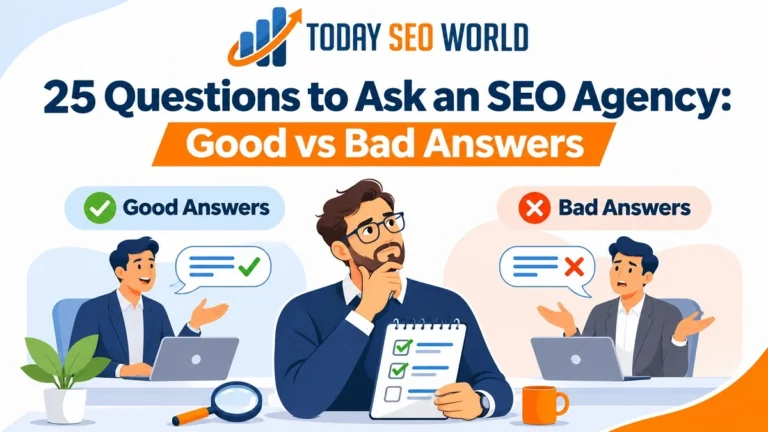
Before you sign, check the scope of work, the notice period and who owns the work if you leave. Our list of questions to ask an SEO agency covers contract terms in detail.
Red Flags in Their Methods and Reporting
These warning signs often appear only after you’ve started. Check for them in proposals, and keep checking once the work begins.
7. They Buy Links or Ask You to Link to Them
Link packages such as “100 high-authority backlinks”, private blog networks and link swaps all break Google’s rules. Google’s spam policies treat buying or selling links for ranking purposes as a link scheme. Sites that break these policies can rank lower or disappear from results.
Google’s hiring advice adds: “Avoid SEOs that talk about link popularity schemes or submitting your site to thousands of search engines.” It also says: “You should never have to link to an SEO.”
Ask instead: “Show me links you’ve earned for clients and explain how you got them.” Good agencies earn links through useful content, original data and digital PR.
8. They Mass-Produce Content
Dozens of near-identical city pages, or hundreds of AI-written articles a month with no expert input, put your site at risk. Google’s spam policies include scaled content abuse: publishing many pages mainly to manipulate rankings rather than help people. This applies whether the pages are made by people, automation or AI.
Using AI isn’t the problem. Publishing volume without value is. Ask who writes your content, who checks it and where the expertise comes from.
9. They Keep Your Accounts, Data or Content in Their Name
If the agency owns your Google Analytics, Search Console, Google Business Profile, domain or hosting, you lose years of data and control when you leave. Be just as careful about handing over full owner access on day one. For an SEO audit, Google’s advice on hiring an SEO is to “only grant read access to Search Console (at this stage, don’t grant them write access).”
Create every account in your company’s name and add the agency as a user you can remove. Your contract should also say that the content and links paid for belong to you.
10. Their Reports Show Only Rankings
Reports full of keyword positions, visibility scores and traffic charts can hide the fact that nothing is improving for your business. Rankings for phrases nobody searches for look good but bring no customers. Automated PDFs with no commentary are another warning sign.
Good reports track three to five KPIs tied to your goals, such as leads, calls or sales from organic search. They also explain the work completed and next month’s priorities.
11. They Have No Proof of Results
No case studies, no references, only client logos or a burst of reviews all posted in the same week should make you cautious. Google suggests asking: “Can you show me examples of your previous work and share some success stories?”
Ask to speak with one or two current clients, and read independent reviews on SEO agency profiles before you decide.
12. They Sell Secret AI Search Tricks
“Guaranteed ChatGPT rankings”, special “GEO markup” or an llms.txt file sold as a magic fix are the newest version of the secret-method pitch. Google’s hiring advice now lists “Optimizing for generative AI” as a normal SEO service. It suggests checking whether an SEO’s advice is “aligned with Google Search’s official guidance on optimizing for generative AI features.”
That guidance says AI search needs no special files or markup. Learn the basics in our guide to GEO vs AEO vs SEO, or compare AI SEO agencies that build AI visibility on solid SEO.
Green Flags: Signs of a Good SEO Agency
A good agency usually shows the opposite habits. Look for an agency that:
- Asks about your business, customers and goals before proposing anything. Google’s advice: “See if the SEO is interested in you and your business. If they’re not interested, find someone who is.”
- Gives a realistic timeframe and explains what affects it
- Explains its methods and shares a change log
- Works in accounts you own
- Shows case studies with business results and offers references
- Agrees KPIs tied to leads or sales
- Backs its advice with Google’s documentation. Google suggests asking: “Do they cite official Google documentation as supporting evidence for their recommendations?”
What to Do If Your Current Agency Shows Red Flags
- Secure your accounts. Make sure your company owns Search Console, Google Analytics, Google Business Profile, your domain, your hosting and your website admin. Remove any access you don’t recognize.
- Ask for a full record of the work. Request a change log and a list of all content published and links built, including where and how.
- Check for a manual action. Open the Manual actions report in Search Console. If Google has taken action, the report explains the issue and how to request a review.
- Review your backlinks. Look for paid links, link networks and spammy sites in Search Console’s Links report or a backlink analysis tool. Use Google’s disavow tool only for large numbers of spammy links you can’t remove that have caused, or are likely to cause, a manual action.
- Give notice as your contract allows, and get the handover of files, content and access in writing.
- Report deception. Google says: “If you feel that you were deceived by an SEO in some way, you may want to report it.” In the US, Google points to the Federal Trade Commission (FTC). Elsewhere, contact your local consumer protection authority.
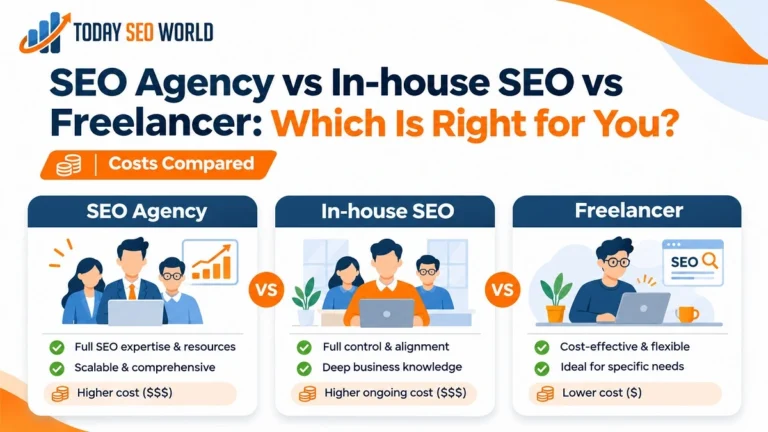
If you’re replacing your agency, it’s also a good time to decide whether an agency is still the right fit. Our comparison of an SEO agency vs in-house SEO vs a freelancer can help.
Find a Trustworthy SEO Agency
Ready to compare agencies? Browse SEO agencies by service, location, budget and team size, and check their reviews before you book a call.
Had a good or bad experience with an SEO agency? Write a review to help other businesses avoid the red flags.
Run an honest SEO agency? Get your agency listed so businesses looking for a trustworthy partner can find you.